
On September 3rd, there was an event in Place Bellecour to commemorate the liberation of Lyon. Around 1 pm, I was making my way through the area when I stumbled upon the very beginning of this event. There were military vehicles from various branches of the U.S. armed forces and I immediately knew that I needed to do more research. In anticipation, of this blog post, I snapped a few photos on my camera. I came across a man, in uniform, and asked if I could take a picture of him in front of one of the vehicles, to which he responded “of course!” (see photo below). After I took his photo he came close to me and in a hushed tone said “shh, I am not an American, i’m sure you could tell” which is ironic considering he was dressed in “USA” embellished garments, next to his “USA” stamped vehicle. With a sincere expression of gratitude for this mans generosity and kind spirit, I continued my exploration.
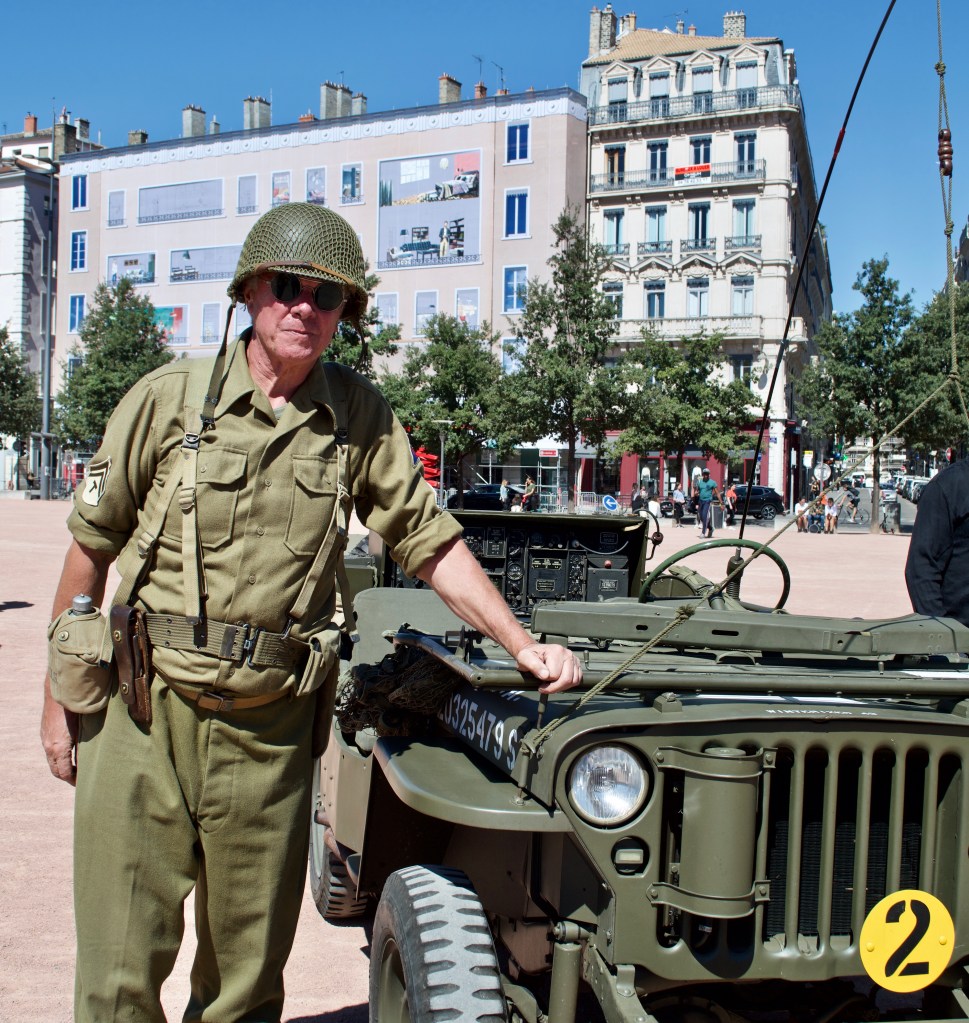
After I finished meandering through the square, still confused as to what was happening, I headed back to the dorms to begin my investigation. I learned that during World War II, Lyon was considered a “free zone” where many refugees were housed. Lyon also established itself as a forefront for multitudes of resistance movements. After the invasion of the southern zone in 1942, Lyon suffered a repression and lost it’s title as a “free zone”. This was mostly because Lyon was a regional base for German repressive dictators like Gestapo, SS and Feldgendarmerie. During this time, more daring resilient movements were taking place which resulted in deaths of important figures. 75 years ago, on September 3rd, 1944, Lyon was liberated from the Nazis by the US military and French armed forces.
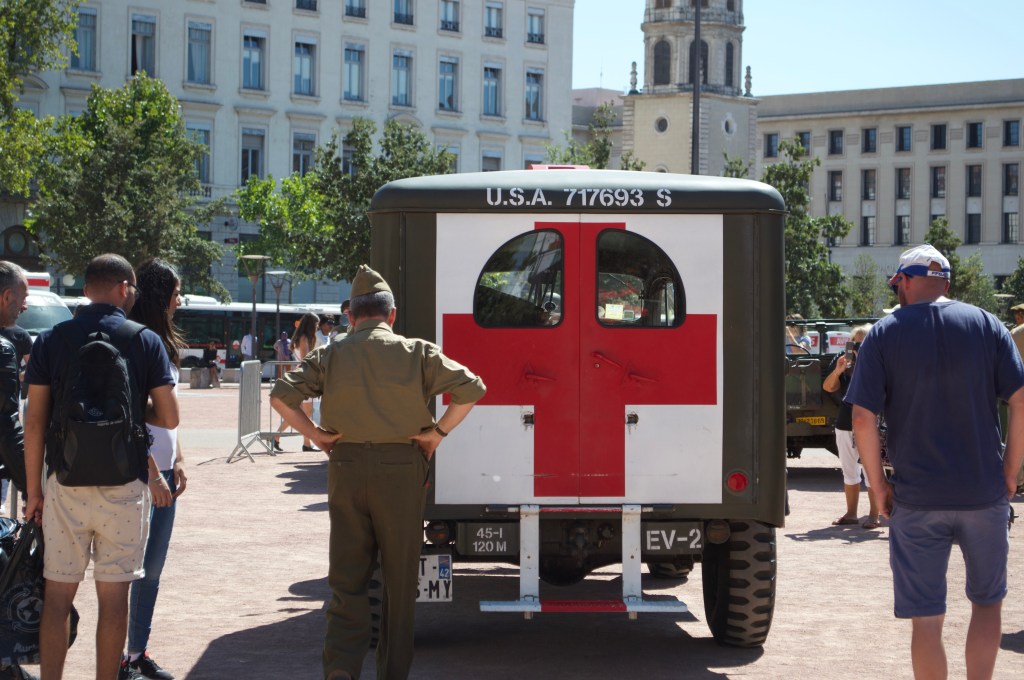
To celebrate the 75th anniversary of the liberation of Lyon, there have been events going on since August. On August 24th, the day of liberation of Montluc, there was an exhibition of archival photos of the liberation at the Grids of the Antonin Poncet Square . On August 31st, there was a City Hall lighting in blue, white, and red symbolizing the flag of France and the pride that it holds. On September 3rd, there were three main events. The first was an exhibition of civilian and military vehicles of WWII, this is what I saw. Later there was an American jazz concert, dance demonstrations, and an official ceremony with testimonies from young winners of the National Contest of Resistance and Deportation.
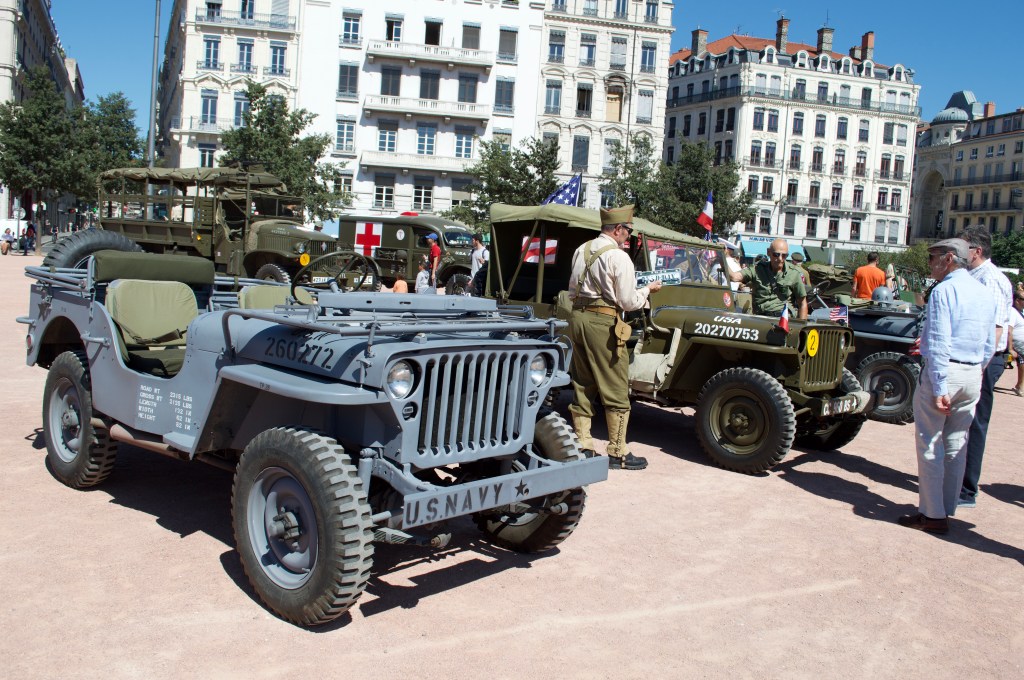
Looking back at time spent in history class when I was younger, I feel that I always learned about major events but missed important details about smaller happenings. I was very grateful to have stumbled upon Place Bellecour on Tuesday because it allowed me an avenue to explore a part of history I hadn’t yet learned about in depth.
 CHID Lyon: Art and innovation 2019
Thank you for doing the research to help us all begin to understand the role of Lyon in WWII. The complexity is something we will explore during our visit to the Centre d’Histoire de la Deportation et de la Resistance that is housed in the former Gestapo headquarters. Your blog post opens a window to yet another dimension of the history of this extraordinary city.
LikeLike