
With one week left, I am starting to reflect on everything I’ve seen. We began this trip by watching the Social Life of Small Urban Spaces, showing us how humans respond to built environments, and preparing us with a sense of our human nature as we go explore the city of Lyon. Following this lesson, we started our group project that focused on defining the “Spirit of Place” in each of our assigned environments. As we visited four different places: Place Bellecour, Place des Jacobins, Place Saint Jean, and Place des Célestins, I gathered highlights of each that were memorable to me. At Place Bellecour, I admired the water fountains that served as a natural contrast to the vast, mostly-dry, pedestrian court. At Place des Jacobins, I was drawn to the circular shaped stairs that outlined the four artists in the center of the intersection. At Place Saint Jean, I felt comfort from lighting a candle inside the shady Cathedral. At Place des Célestins, I was amazed at how the periscope(?) presented a mysterious turning mirror inside a car park. As a way to visually understand placemaking, I decided to interpret it in a collage.
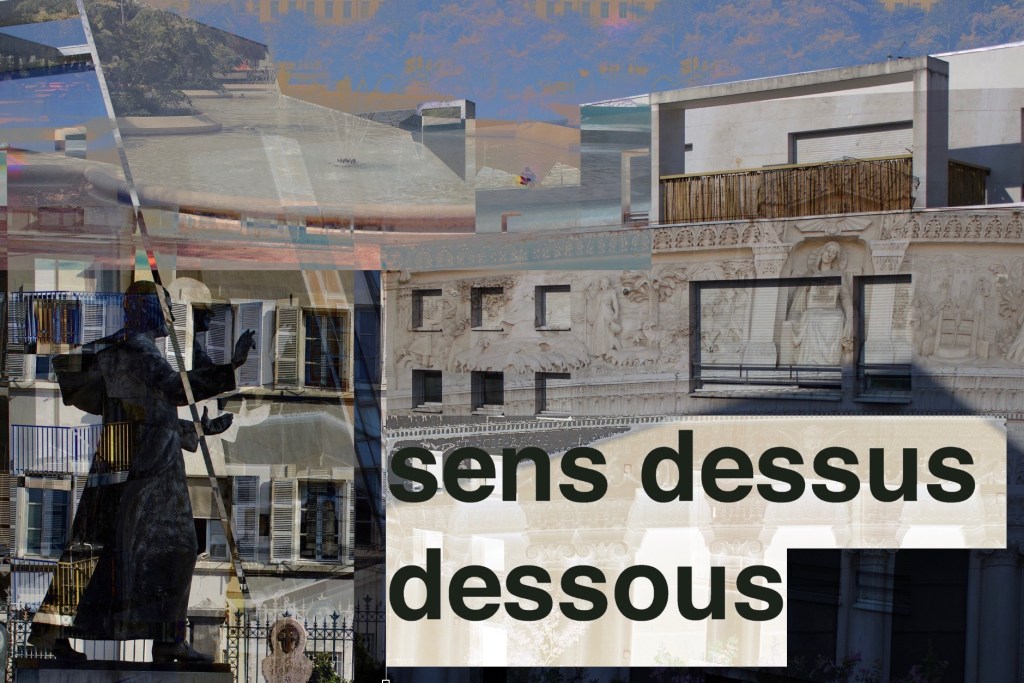
On the right, I merged an image of the basilica onto the apartment building facing my window. I’ve noticed so many embellishments on regular buildings, street art, and quiet alleyways along the way and I wanted to reimagine this in a different way. On the top left, I included the fountains at Place Bellecour as a way to create a nature contrast between building and figure. An image of the statue from the basilica faces “sens dessus dessous,” an expression that stuck with me throughout this trip. This phrase means upside down, and I found this interesting because 1. it was named after the car park with the angled mirror and 2. because while we were learning about place-making’s way of organizing space, I interpreted sens dessus dessous as stirring something up, or causing disorder. It was almost like something was “brewing” underneath the calm Place des Jacobins. Although this phrase probably faces no connection with the rest of the space above it, it was nonetheless intriguing to me.
Starting from day one, the notion of intentionality was introduced to us very clearly. To choose, to wonder, and to think about what we see as processes rather than just a product. The best way to begin seems to be putting ourselves in any position– like Lauren Murlot with his work in Cook, Australia, and like Jan Kopp with his poppy seeds at the ruins of the Berlin Wall.
Lyon has showed me how art fosters a community by including me in all of its own intentionality, and I know I’ll continue practicing these ideas in as many ways as I can.
 CHID Lyon: Art and innovation 2019